
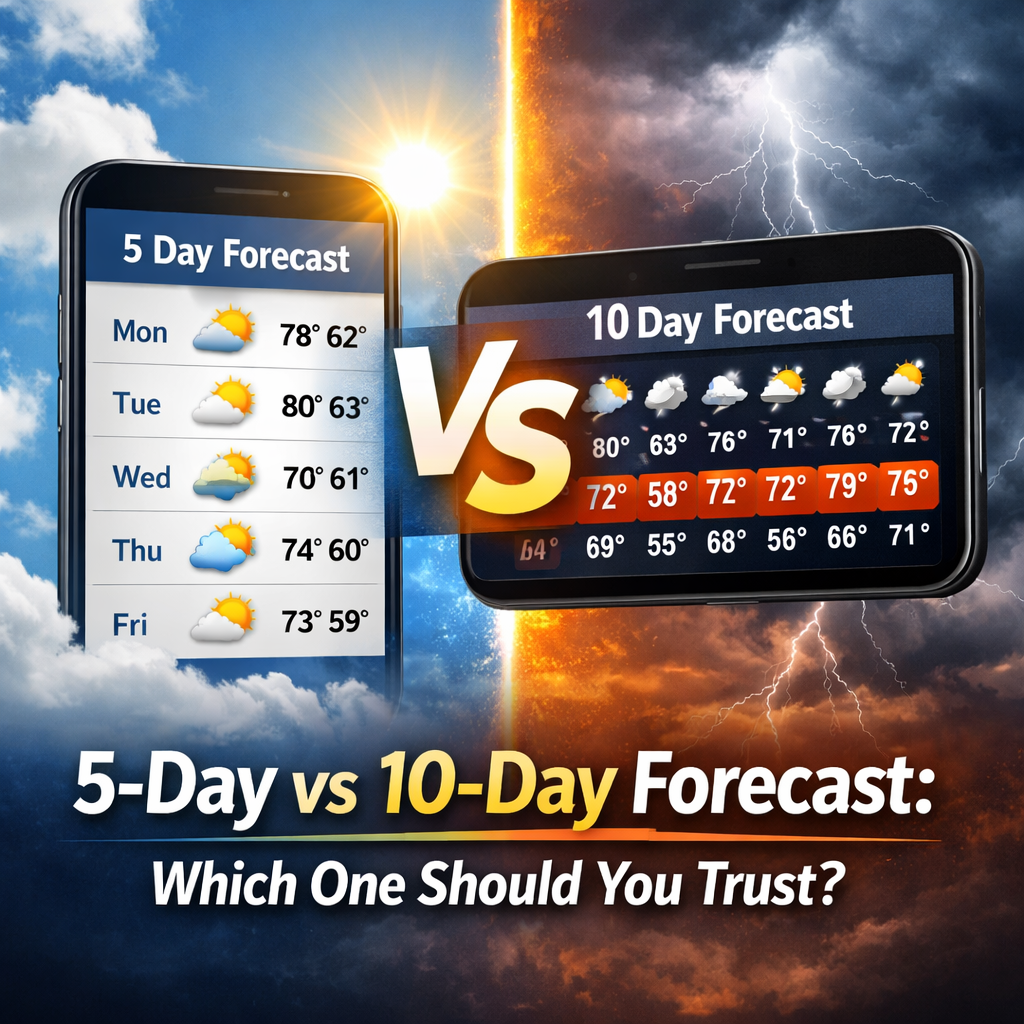
When planning a trip, event, or even your weekly outfits, weather forecasts play a big role. But here’s the big question:
Should you trust the 5-day forecast more than the 10-day forecast?
The short answer: Yes — but it depends on what you’re planning.
Let’s break it down in simple terms so you know exactly how to use each forecast wisely.
Understanding How Weather Forecasts Work
Weather forecasts are created using:
-
🌍 Satellite data
-
📡 Radar observations
-
🌡️ Surface weather stations
-
🧮 Complex computer models
These computer models simulate how the atmosphere will behave in the future. But because weather systems are constantly changing, predictions become less reliable the further out they go.
Think of it like predicting traffic:
-
Tomorrow morning’s traffic? Fairly predictable.
-
Traffic 10 days from now? Nearly impossible to know exactly.
The same principle applies to weather.
Why 5-Day Forecasts Are More Reliable
A 5-day forecast is generally considered highly dependable for:
-
Temperature trends
-
Rain chances
-
Major weather systems
-
Storm tracking
Meteorological studies consistently show that forecast accuracy is strongest within the first 3–5 days.
What You Can Confidently Trust in a 5-Day Forecast:
✔ Whether a cold front is coming
✔ General temperature range
✔ High probability rain events
✔ Major storms or heatwaves
Small timing changes may happen, but overall trends are usually accurate.
The Reality of 10-Day Forecasts
A 10-day forecast is better viewed as a trend outlook rather than a precise prediction.
Beyond 5–7 days:
-
Small atmospheric changes grow exponentially
-
Model differences increase
-
Timing becomes uncertain
-
Rain probability becomes less reliable
By day 8–10, forecasts are often adjusted significantly as new data becomes available.
What a 10-Day Forecast Is Good For:
✔ Seeing overall temperature trends
✔ Noticing possible weather pattern shifts
✔ Early awareness of potential rain periods
✔ Long-range planning flexibility
It is not ideal for locking in outdoor wedding times or critical travel decisions.
Why Forecast Accuracy Drops Over Time
Weather is a chaotic system.
Tiny changes in:
-
Wind direction
-
Pressure systems
-
Ocean temperatures
-
Jet stream position
can dramatically alter outcomes several days later.
This is called the “butterfly effect” in atmospheric science — small changes today can create large differences later.
That’s why a forecast for next weekend might change three times before you get there.
Accuracy Comparison: 5-Day vs 10-Day
Here’s a simple comparison:
| Feature | 5-Day Forecast | 10-Day Forecast |
|---|---|---|
| Temperature Accuracy | High | Moderate |
| Rain Probability | Reliable | Less Reliable |
| Storm Tracking | Strong | Weak (timing uncertain) |
| Long-Term Trend View | Limited | Good |
| Best For | Short-term planning | Flexible long-range planning |
When to Use Each Forecast
Use the 5-Day Forecast When:
-
Planning outdoor events
-
Scheduling travel
-
Organizing sports games
-
Preparing for storms
-
Making clothing decisions
Use the 10-Day Forecast When:
-
Exploring potential travel windows
-
Watching for seasonal shifts
-
Getting an early sense of changing weather
-
Checking if a heatwave might develop
The “Update Rule” You Should Follow
If you want to make smart decisions:
-
Check the 10-day forecast for general awareness
-
Start relying seriously on weather details 3–5 days out
-
Recheck daily as the date approaches
The closer you get to the event, the more accurate the forecast becomes.
Why Forecasts Keep Changing
Many people think forecast changes mean meteorologists were “wrong.”
In reality:
-
Forecast models update multiple times daily
-
New satellite and radar data improves accuracy
-
Small atmospheric shifts refine predictions
Forecast changes are actually a sign of improving precision, not failure.
How to Read Long-Range Forecasts Smartly
Instead of focusing on exact rain percentages on day 10:
Look for:
-
Consistent temperature trends
-
Large storm systems
-
Pattern consistency across several days
-
Whether multiple updates show similar results
If the forecast keeps flipping dramatically, confidence is low.
If it remains stable across updates, confidence increases.
What About Seasonal Forecasts?
Anything beyond 10–14 days shifts into outlook territory rather than precise forecasting.
Seasonal outlooks can suggest:
-
Warmer-than-average periods
-
Cooler-than-average months
-
Increased rainfall likelihood
But they cannot predict exact rainy days weeks ahead.
Final Verdict: Which One Should You Trust?
If you need reliability:
👉 Trust the 5-day forecast.
If you’re planning ahead and just need a general idea:
👉 Use the 10-day forecast for trends only.
The best strategy is to combine both:
-
Long-range = awareness
-
Short-range = action
Weather forecasting is incredibly advanced today—but nature always keeps a little unpredictability.
Frequently Asked Questions (FAQ)
1. Is a 5-day forecast accurate?
Yes. Modern 5-day forecasts are generally very accurate for temperature and major weather systems.
2. How accurate is a 10-day forecast?
It’s reasonably accurate for general trends but less reliable for specific timing and rain details.
3. Why does the forecast change every day?
Forecast models update with new atmospheric data multiple times daily, refining predictions.
4. Can weather be predicted 2 weeks in advance?
Not precisely. Beyond 10–14 days, forecasts become trend-based outlooks rather than exact predictions.
5. Should I cancel outdoor plans based on a 10-day forecast?
Not immediately. Recheck the forecast as the date approaches for higher accuracy.