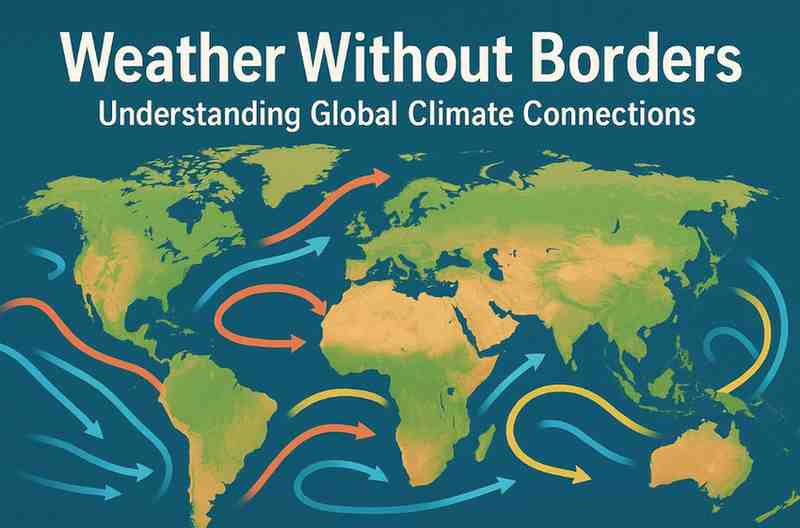
Weather Without Borders: Understanding Global Climate Connections
In our interconnected world, the weather we experience in one corner of the planet is no longer just a local affair. A storm that brews over the Pacific can alter rainfall patterns in India. A heatwave in Europe may be linked to shifting Arctic winds. And the melting of polar ice influences monsoon behavior thousands of miles away.
This is the age of global weather interconnection — where the climate behaves like one vast, dynamic system with no borders or boundaries.
In this article, we’ll explore how global weather systems are linked, how climate change intensifies those links, and why understanding these patterns is crucial for predicting the weather of tomorrow.
- A Planet Connected by Air and Ocean
To understand global weather, we first need to look at the two powerful forces that move energy around our planet:
the atmosphere and the oceans.
The Atmospheric Circulation
The Earth’s atmosphere constantly redistributes heat from the equator (where sunlight is strongest) toward the poles (where it’s weakest). This movement happens through large-scale wind patterns known as Hadley cells, Ferrel cells, and Polar cells.
- Hadley Cells: These drive the trade winds and control tropical weather systems, including monsoons.
- Ferrel Cells: These influence mid-latitude storms and rainfall belts.
- Polar Cells: These govern cold air masses and Arctic winds.
When any of these cells shift — due to warming, jet stream changes, or ocean temperature variations — the entire global climate responds.
The Ocean Conveyor Belt
The second major player is the global ocean current system, sometimes called the thermohaline circulation.
Warm and cold ocean waters travel vast distances, carrying heat energy that influences regional climates.
For example:
- The Gulf Stream warms Europe, keeping winters milder than expected for its latitude.
- The Pacific’s warm pool affects monsoon strength across Asia.
- The El Niño–Southern Oscillation (ENSO) changes rainfall patterns across continents — from droughts in Africa to floods in South America.
Together, the atmosphere and ocean act like a massive global engine — one that powers the weather we see every day.
- El Niño, La Niña, and the Domino Effect
Few phenomena illustrate global weather Forecast connections better than El Niño and La Niña.
El Niño: The Global Warm Current
Every few years, the Pacific Ocean warms unusually near the equator, disrupting normal wind and rain patterns.
This phase — known as El Niño — brings:
- Drier weather to India, Indonesia, and Australia
- Warmer winters in North America
- Floods in South America
- Global temperature spikes
La Niña: The Cooling Counterpart
The opposite phase, La Niña, occurs when Pacific waters are cooler than normal.
It often leads to:
- Stronger monsoons in South Asia
- Harsher winters in Canada and the northern U.S.
- Drought in South America
- A global temperature dip
What’s fascinating is that one ocean phenomenon can trigger weather shifts across multiple continents.
It’s like throwing a pebble into the Pacific — the ripples reach the world.
- Jet Streams: The Invisible Highways of Weather
High above our heads, powerful bands of fast-moving air known as jet streams circle the planet. These narrow air currents guide storms, influence rainfall, and determine how quickly weather systems move.
When jet streams meander unusually far north or south, they can cause weather extremes:
- Europe’s 2022 heatwave was linked to a stalled jet stream.
- The U.S. experienced prolonged cold spells when Arctic air slipped southward due to weakened jet flow.
- Asia’s heavy rainfall and heat anomalies often tie back to jet stream shifts influenced by El Niño.
Jet streams act as global weather connectors, binding continents together under shared atmospheric rhythms.
- The Polar Connection: Melting Ice, Changing Winds
In recent years, scientists have paid close attention to the Arctic, one of the fastest-warming regions on Earth.
But why should someone in India or the United States care about Arctic warming?
Because as the poles heat up:
- The temperature contrast between the poles and the equator decreases.
- This weakens the jet streams, allowing cold Arctic air to spill southward.
- The result? Unusual cold spells in places like Texas, Japan, or Europe.
Meanwhile, Antarctic ice loss is affecting ocean currents that regulate global sea levels and climate balance.
It’s a stark reminder that the polar regions are not isolated — they shape weather across the globe.
- Monsoons and Their Global Links
Monsoons — the seasonal wind and rain patterns critical to billions of people — are also influenced by global systems.
The Indian Monsoon
The Indian monsoon’s strength depends not only on the Indian Ocean but also on:
- El Niño (often weakens it)
- La Niña (strengthens it)
- Indian Ocean Dipole (IOD) — a warming or cooling of the western vs. eastern Indian Ocean that modifies rainfall.
The African and East Asian Monsoons
Similarly, African and East Asian monsoons show teleconnections — meaning distant climate patterns can affect them.
A strong El Niño, for example, can reduce African rains but increase rainfall in China’s southern provinces.
These cross-continental patterns highlight how monsoons are not just local phenomena but global climate expressions.
- How Climate Change Is Rewriting the Global Weather Script
In the 21st century, climate change has amplified these natural connections.
Rising greenhouse gases, ocean warming, and melting ice are altering atmospheric and oceanic systems on a global scale.
More Energy, More Extremes
A warmer planet holds more moisture — about 7% more per 1°C of warming.
That means:
- Heavier rainfall and flash floods
- Stronger cyclones
- Longer droughts between wet periods
Shifting Jet Streams and Ocean Currents
Climate change has caused jet streams to slow and wobble, creating “blocking patterns” where weather systems stay stuck.
This leads to prolonged heatwaves or cold snaps — like those seen in 2023–2024 across Europe and Asia.
Meanwhile, ocean currents like the Atlantic Meridional Overturning Circulation (AMOC) are showing signs of slowing.
If disrupted further, they could reshape global temperature distributions and monsoon patterns dramatically.
A Global Domino Effect
In essence, global warming turns local events into global chain reactions:
- Arctic melt → Jet stream shift → U.S. winter storm
- Pacific warming → Indian drought → African heatwave
- Amazon deforestation → Rainfall drop → Global carbon imbalance
Every system now affects every other — reinforcing that weather truly knows no borders.
- Technology and Global Forecasting: Predicting the Unpredictable
Understanding global weather connections is no longer just academic — it’s vital for survival.
Thanks to modern technology, we can now track and predict these interactions with unprecedented accuracy.
Supercomputers and Global Models
Weather agencies like NASA, ECMWF, and the IMD use supercomputers to simulate Earth’s climate using billions of data points.
These models incorporate:
- Satellite data
- Ocean temperature readings
- Atmospheric pressure systems
By comparing global patterns, scientists can predict El Niño onset, monsoon behavior, and cyclone tracks weeks or months in advance.
AI and Climate Forecasting
Artificial intelligence (AI) now plays a growing role in forecasting:
- Machine learning models detect global correlations faster than humans.
- AI can simulate multi-continent effects of ocean or jet stream shifts.
- Real-time data improves early warnings, saving lives in cyclone-prone regions.
The Global Weather Network
Today’s weather forecasts are the result of international cooperation — satellites, ships, and ground stations share data globally.
This cross-border teamwork exemplifies how understanding global weather requires global unity.
- Why Global Awareness Matters
The interconnected nature of global weather means no country stands alone in facing climate challenges.
- A drought in Africa can affect global food prices.
- A typhoon in Asia can disrupt global trade routes.
- Heatwaves in Europe influence global energy demand.
Understanding these links helps governments, businesses, and individuals make informed decisions — from agriculture to disaster preparedness.
Building Climate Resilience
To adapt to a borderless weather system, we need:
- Stronger global climate cooperation
- Sustainable resource management
- Investments in renewable energy
- Public awareness and education
Because when the planet’s weather systems change, every community feels the impact — directly or indirectly.
- The Road Ahead: Adapting to a Shared Sky
The future of weather forecasting and climate adaptation lies in collaboration.
No single nation can combat the impacts of global weather shifts alone.
We must continue to:
- Share real-time meteorological data
- Invest in cross-border early warning systems
- Support climate research that studies Earth as one unified system
Whether it’s predicting monsoons, mitigating floods, or managing droughts, our response must be as interconnected as the weather itself.
Conclusion: One Planet, One Weather System
The phrase “Weather Without Borders” captures an undeniable truth — the atmosphere belongs to no one nation.
Every gust of wind, every drop of rain, and every heatwave is part of a shared global rhythm.
As technology evolves and our understanding deepens, we’re learning that climate awareness is global citizenship.
From policymakers to farmers, from meteorologists to ordinary citizens, we all share the same sky — and with it, the responsibility to protect and understand it.
In the 21st century, weather is no longer local — it’s global, dynamic, and deeply interconnected.
Recognizing this connection is the first step toward building a safer, more sustainable future on our ever-changing planet.