October 2026 Outlook: Post-Monsoon Surprises and Storm Signals
As India transitions from the monsoon’s waning days to the crisp onset of autumn, October 2026 Outlook arrives as a month of contrasts — calm skies in some regions and brewing storm signals in others. Traditionally, October marks the retreat of the southwest monsoon and the beginning of the northeast monsoon over southern India. But this year, weather watchers, farmers, and coastal communities alike have noticed something unusual — the post-monsoon pattern has shifted, and the atmosphere is carrying unexpected twists.
In this detailed outlook, we’ll break down what’s happening across India and beyond — from delayed monsoon withdrawals to tropical storm developments, rainfall trends, temperature forecasts, and the broader climatic influences shaping October 2026.
- The Post-Monsoon Transition: When Summer Meets Winter
October is often described as India’s “transition month” — a period when the monsoon loses its grip and dry, pleasant weather forecast slowly returns. However, in 2026, this transition is proving more erratic than expected.
Delayed Monsoon Withdrawal
According to the India Meteorological Department (IMD), the withdrawal of the southwest monsoon from northwest India began nearly a week later than average this year. Normally, by early October, large parts of the northern plains — including Delhi, Punjab, Haryana, and Rajasthan — start experiencing dry conditions. Instead, isolated showers continued into the second week of October.
Meteorologists attribute this delay to:
- Lingering moisture from the Bay of Bengal.
- A slower shift of wind patterns toward northeasterly flow.
- Warmer sea surface temperatures (SSTs) across the Arabian Sea and Bay of Bengal, which are fueling convection longer than usual.
The delay in withdrawal has pushed back the onset of autumn in northern and central India. Nights remain warm, humidity is higher, and air quality in urban centers like Delhi and Lucknow hasn’t deteriorated yet — a rare early-October relief.
- The Northeast Monsoon’s Early Signals
While the southwest monsoon retreats from the northwest, southern India begins to prepare for the northeast monsoon (NE monsoon) — the key rainy season for Tamil Nadu, parts of Andhra Pradesh, and coastal Karnataka.
In October 2025, early indicators suggest an active start to the NE monsoon:
- Strong easterly winds have developed over the Bay of Bengal.
- Above-average sea temperatures (1–1.5°C higher than normal) are creating fertile conditions for rainfall systems.
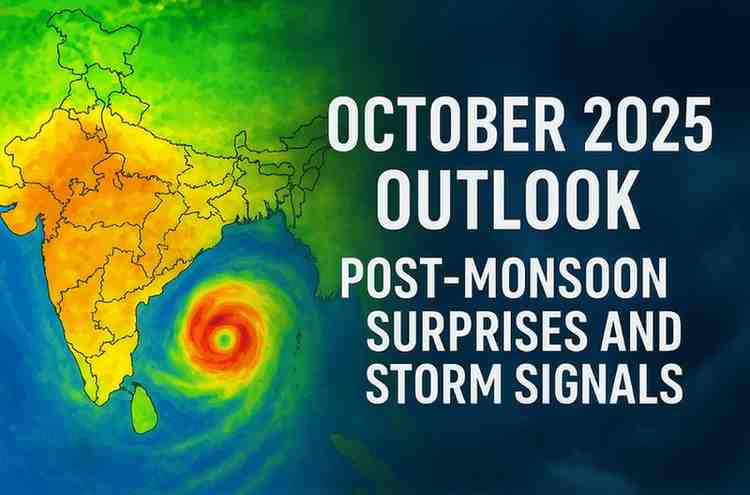
- A developing low-pressure area (LPA) near the Andaman Sea may strengthen into a depression, potentially becoming the first northeast monsoon storm of the season.
If this system intensifies, it could bring heavy rainfall to Tamil Nadu and Puducherry in late October — marking a dynamic start to the season. Chennai, which often receives around 27% of its annual rainfall in October, may experience above-average precipitation this year.
- Storm Signals Over the Bay of Bengal
October is historically cyclone season in the North Indian Ocean basin, especially the Bay of Bengal. Warm sea surfaces and shifting wind shear create ideal conditions for tropical cyclone formation.
Current Conditions (Late October 2026)
Meteorological models from ECMWF and IMD hint at two potential storm developments in the coming weeks:
- A possible depression forming in the east-central Bay of Bengal (Oct 25–28).
- A follow-up low-pressure zone expected around the first week of November, possibly influenced by the Madden–Julian Oscillation (MJO) phase.
While it’s too early to predict landfall paths, Odisha and West Bengal’s coastal zones are on alert for rough seas and squally winds. Fishermen have been advised to avoid deep-sea ventures until further updates.
Recent Cyclonic Trends
In the last decade, the frequency of late-season storms has increased, and many have shown unpredictable tracks — thanks to climate variability and warmer ocean temperatures. For instance:
- Cyclone Sitrang (October 2022) rapidly intensified before striking Bangladesh.
- Cyclone Tej (October 2023) crossed from the Arabian Sea to the Gulf of Aden, defying historical tracks.
With 2025’s El Niño phase still lingering (though weakening), oceanic heat is expected to keep cyclone potential above normal through November.
- Regional Weather Breakdown: North to South
Let’s take a closer look at what October 2026 has meant region by region across India.
North India: Lingering Warmth and Late Rains
- Delhi, Punjab, Haryana, Rajasthan: After an extended wet spell, skies are finally clearing by late October. Temperatures, however, remain slightly above normal — maximums near 34°C in Delhi and 31°C in Jaipur. The delayed withdrawal has postponed the onset of crisp autumn mornings.
- Fog conditions are expected to develop by late October as humidity persists overnight.
- Air quality remains moderate, but crop residue burning could worsen AQI levels in early November.
Central India: A Wet October End
- Madhya Pradesh and Chhattisgarh recorded 30–40% excess rainfall in early October due to residual monsoon systems.
- As the monsoon withdraws, daytime heat returns briefly, but cooler nights are beginning to settle in.
- Nagpur and Bhopal are seeing average highs of 32–33°C, while minimums dip to 20–21°C.
Western India: Gradual Cooling and Dry Skies
- Gujarat and Maharashtra experience a stable transition with dry conditions after sporadic early-October showers.
- Mumbai’s humidity remains high, but rainfall activity has mostly ceased.
- Kutch and Saurashtra are entering their dry season, with winds turning northeasterly.
Southern India: Rain Gains Strength
- The focus now shifts to Tamil Nadu, Kerala, and coastal Andhra Pradesh, where northeast monsoon rainfall begins ramping up.
- Chennai and Puducherry saw early drizzles by mid-October, a precursor to heavier rains expected late in the month.
- Kerala, though less dependent on the NE monsoon, continues to receive scattered showers due to moisture spillover from the Bay.
Eastern India and Northeast: Storm Watch
- Odisha and West Bengal remain under watch for possible Bay of Bengal storms.
- Northeast states like Assam and Meghalaya have seen isolated rainfall, but overall activity is tapering off.
- Kolkata enjoys pleasant weather post-Durga Puja, though late-October humidity persists.
- Temperature and Climate Trends
The temperature profile of October 2025 showcases subtle but significant deviations from historical norms.
| Region | Avg Max Temp | Deviation | Comment |
| North India | 33–35°C | +1.5°C | Warmer than normal |
| Central India | 31–33°C | +1.0°C | Mildly above normal |
| South India | 29–32°C | Near normal | Moist air keeps it balanced |
| East India | 30–32°C | +0.8°C | Humid and cloudy conditions |
The warmer-than-usual post-monsoon phase aligns with broader climate patterns observed globally in 2025. Both land and ocean temperatures are trending above average, leading to:
- Delayed seasonal shifts
- More intense local storms
- Prolonged humidity across plains and coasts
- Global Weather Influences: El Niño’s Fading Grip
A key player in this year’s unusual October weather is the waning El Niño event that began in mid-2024. El Niño typically brings:
- Drier conditions over India’s monsoon belt
- Warmer-than-average temperatures
- Increased cyclone activity in the Bay of Bengal
Now, as El Niño weakens and a neutral ENSO phase approaches, global models predict:
- More active northeast monsoon rains
- Near-normal winter onset
- Stable temperature patterns from December onward
However, climate scientists caution that oceanic heat content remains high, meaning weather variability may continue to surprise through the end of 2026.
- Agriculture and Water Outlook
October’s weather carries major implications for India’s agricultural sector — especially for rabi crop planning.
Soil Moisture and Sowing Conditions
- In central and eastern India, late rains have improved soil moisture for wheat and gram sowing.
- In contrast, northwestern states face slightly delayed field preparations due to the prolonged wet spell.
Reservoir Levels
- As of late October, India’s major reservoirs are 90–95% full, according to the Central Water Commission (CWC).
- This ensures ample irrigation supply for the upcoming rabi season.
- Southern reservoirs in Tamil Nadu and Andhra Pradesh are expected to gain further inflows once the northeast monsoon peaks in November.
- Storm Preparedness and Early Warning
Given the increasing unpredictability of post-monsoon storms, authorities have stepped up preparedness measures this October:
- IMD has improved early warning dissemination through its Mausam app and social media alerts.
- NDMA and coastal states have updated evacuation protocols for cyclone-prone regions.
- Coastal radar coverage and satellite imaging have been enhanced to track developing systems in real time.
Residents along the east coast — particularly Odisha, Andhra Pradesh, and Tamil Nadu — are urged to stay alert through November, when cyclone frequency typically peaks.
- Looking Ahead: November 2026 and Beyond
As October gives way to November, India’s weather story will shift yet again:
- The northeast monsoon will intensify, bringing wet weeks for the south.
- Northern India will begin to cool rapidly, with fog and early winter conditions developing by mid-November.
- The Bay of Bengal cyclone window remains open through early December, keeping forecasters vigilant.
Climate watchers suggest 2026’s post-monsoon season could end wetter than average — a sign of how global climate shifts continue to alter India’s seasonal rhythm.
- Final Thoughts: A Season of Shifting Signals
The October 2025 outlook underscores one undeniable truth — weather is changing faster than we expect. What used to be a predictable retreating monsoon month now exhibits new behaviors: delayed withdrawals, persistent storms, and uneven rainfall patterns.
While much of India enjoys the beauty of clear skies and cooling evenings, the atmosphere reminds us to stay prepared. The post-monsoon surprises and storm signals of 2025 highlight the need for:
- Accurate local forecasting
- Sustainable water management
- Resilient agricultural planning
- And above all, climate awareness
In the coming weeks, as the northeast monsoon deepens and cyclonic activity peaks, India’s weather watchers — from professionals to the public — will keep a close eye on every cloud, wave, and wind shift.
Because in October 2025, the season’s calm comes with an undercurrent of change.