
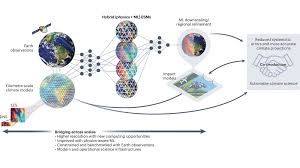
Weather forecasting has always been a complex science. Predicting atmospheric conditions requires analyzing enormous amounts of data collected from satellites, radar systems, weather stations, and ocean buoys. Traditionally, meteorologists relied on numerical weather prediction models that use mathematical equations to simulate atmospheric behavior.
However, the rise of Artificial Intelligence (AI) is transforming how weather predictions are made. AI can process massive datasets faster, recognize patterns humans may miss, and improve the accuracy of forecasts. As climate patterns become more unpredictable, AI is playing an increasingly important role in helping meteorologists deliver faster and more reliable weather forecasts.
In this article, we explore how AI is revolutionizing weather forecasting and why it is becoming a key technology for predicting the weather of the future.
The Challenges of Traditional Weather Forecasting
Weather forecasting has always relied on complex physical models that simulate atmospheric conditions. These models process data such as:
-
Temperature
-
Air pressure
-
Wind speed
-
Humidity
-
Ocean temperature
-
Satellite imagery
While these models are powerful, they also have limitations. Traditional forecasting systems require extremely high computational power and may take hours to produce results. Even with advanced supercomputers, predicting weather accurately beyond several days remains difficult.
Weather systems are also highly chaotic. Small changes in atmospheric conditions can lead to dramatically different outcomes, a concept often referred to as the “butterfly effect.”
This is where Artificial Intelligence is helping transform forecasting methods.
What Is AI-Based Weather Forecasting?
AI-based weather forecasting uses machine learning algorithms to analyze historical and real-time weather data. These algorithms learn patterns from past weather conditions and apply that knowledge to predict future weather.
Unlike traditional models that rely solely on physical equations, AI models focus on data-driven predictions. They identify relationships between variables that might not be obvious in conventional forecasting models.
AI systems are trained using enormous datasets that include:
-
Satellite imagery
-
Radar data
-
Climate records
-
Atmospheric measurements
-
Historical weather patterns
By processing these datasets, AI can produce forecasts faster and often with improved accuracy.
Faster Data Processing with AI
One of the biggest advantages of AI in weather forecasting is speed. Weather models require processing huge amounts of data collected every minute from around the world.
AI algorithms can analyze this data much faster than traditional systems. Machine learning models can quickly identify patterns in atmospheric behavior and generate forecasts within minutes.
This speed is extremely valuable in situations such as:
-
Severe storm predictions
-
Hurricane tracking
-
Flash flood warnings
-
Extreme heat alerts
Faster forecasting allows authorities to issue early warnings, potentially saving lives and reducing damage.
Improved Forecast Accuracy
AI models are becoming increasingly effective at improving forecast accuracy. Machine learning algorithms continuously learn from new weather data and adjust their predictions over time.
Traditional forecasting models sometimes struggle with predicting localized weather events, such as:
-
Sudden thunderstorms
-
Short-term rainfall patterns
-
Localized temperature fluctuations
AI can analyze high-resolution data from radar and satellites to provide more precise predictions for specific regions.
In recent years, several AI-powered weather models have shown accuracy levels comparable to traditional forecasting systems while requiring significantly less computational power.
AI and Satellite Weather Data
Modern weather satellites generate massive amounts of data every day. These satellites monitor clouds, storms, ocean temperatures, and atmospheric changes across the globe.
AI helps meteorologists analyze this satellite data efficiently. Machine learning systems can automatically detect:
-
Storm formation
-
Cyclone development
-
Cloud patterns
-
Temperature anomalies
Instead of manually reviewing thousands of satellite images, AI systems can quickly identify significant weather events and alert meteorologists.
This allows weather agencies to monitor developing storms more effectively.
AI for Extreme Weather Prediction
Extreme weather events are becoming more frequent due to climate change. Predicting these events accurately is crucial for disaster preparedness.
AI systems are now being used to improve forecasts for:
-
Hurricanes and cyclones
-
Floods and heavy rainfall
-
Heatwaves
-
Severe storms
-
Wildfire conditions
By analyzing historical storm patterns and atmospheric conditions, AI models can identify early warning signs of extreme weather events.
This helps governments and emergency services prepare for disasters in advance.
AI and Short-Term Weather Forecasting
Short-term forecasts, also known as nowcasting, focus on predicting weather conditions for the next few hours.
Nowcasting is especially important for predicting events like:
-
Sudden rainfall
-
Thunderstorms
-
Fog
-
Lightning
AI-powered systems are particularly effective at nowcasting because they can analyze real-time radar and satellite data instantly.
Machine learning models can track storm movements and predict rainfall patterns in near real-time, providing highly localized forecasts.
AI Reducing Forecasting Costs
Traditional weather models require powerful supercomputers to run complex atmospheric simulations. These systems are expensive and require significant energy resources.
AI models can often deliver comparable results while using fewer computing resources. This makes advanced forecasting more accessible to smaller meteorological organizations and developing countries.
Reduced computing costs also allow weather agencies to run forecasts more frequently, improving overall accuracy.
AI and Climate Research
Beyond daily forecasts, AI is also helping scientists understand long-term climate trends. Machine learning algorithms can analyze decades of climate data to identify patterns related to:
-
Global warming
-
Changing rainfall patterns
-
Rising sea levels
-
Temperature trends
AI tools can process climate datasets much faster than traditional statistical methods. This helps researchers study climate change more effectively and improve long-term climate predictions.
Real-World Examples of AI Weather Forecasting
Several technology companies and research organizations are already using AI to improve weather predictions.
Examples include:
Google DeepMind
DeepMind developed an AI-based weather prediction system capable of forecasting rainfall with impressive accuracy.
IBM Weather Company
IBM uses AI and machine learning to analyze weather data and deliver highly localized forecasts.
European Weather Agencies
Several European meteorological agencies are integrating AI systems into their forecasting models to enhance prediction accuracy.
These innovations demonstrate how AI is becoming a central component of modern meteorology.
The Future of AI in Weather Forecasting
Artificial Intelligence is still evolving, and its role in weather forecasting will continue to grow. Future AI systems may offer even more advanced capabilities, including:
-
Hyper-local weather predictions
-
More accurate hurricane tracking
-
Improved climate change models
-
Real-time disaster prediction systems
As computing technology advances and more weather data becomes available, AI-powered forecasting models will continue to improve.
The combination of traditional meteorological science and AI-driven data analysis is expected to create the next generation of highly accurate weather prediction systems.
Conclusion
Artificial Intelligence is revolutionizing the field of weather forecasting. By processing enormous datasets, recognizing hidden patterns, and generating predictions quickly, AI is helping meteorologists deliver more accurate and timely forecasts.
From improving storm predictions to enhancing climate research, AI is becoming an essential tool for understanding Earth’s atmosphere. As weather patterns grow more unpredictable due to climate change, AI-driven forecasting will play a critical role in helping communities prepare for extreme weather events.
The future of weather forecasting is increasingly powered by intelligent technology—and AI is leading the way.
Frequently Asked Questions (FAQs)
1. How does AI help in weather forecasting?
AI analyzes large datasets from satellites, weather stations, and radar systems to identify patterns and generate more accurate weather predictions.
2. Is AI more accurate than traditional weather models?
AI models can improve forecast accuracy, especially for short-term predictions and localized weather events, though they are often used alongside traditional models.
3. Can AI predict extreme weather events?
Yes. AI systems can analyze historical weather data and atmospheric patterns to detect early signs of storms, hurricanes, and heatwaves.
4. Why is AI important for future weather forecasting?
AI can process massive amounts of data quickly, improving forecasting speed and accuracy while reducing computational costs.
5. Will AI replace meteorologists?
No. AI assists meteorologists by analyzing data and generating predictions, but human expertise is still essential for interpreting weather models and issuing forecasts.