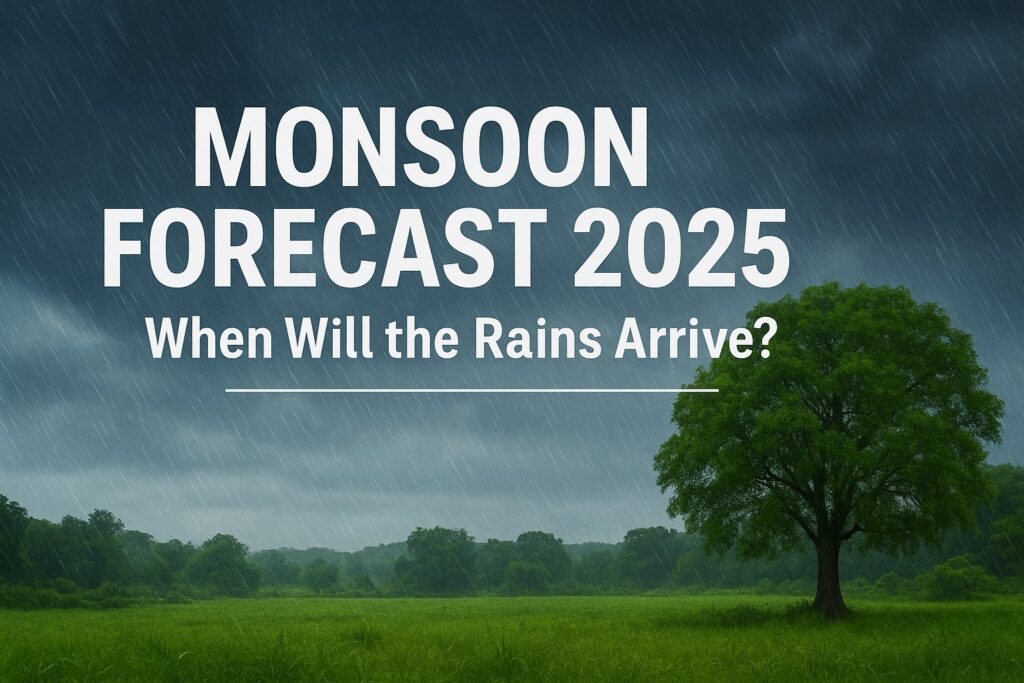
Monsoon Forecast 2025: When Will the Rains Arrive?
Introduction: The Anticipation of the Monsoon
Monsoon Forecast 2025, Every year, as the scorching summer heat intensifies across South Asia, millions of people look skyward, waiting for the first drops of the monsoon. The 2025 monsoon season is no exception. From farmers planning their crops to city dwellers praying for relief from the heat, the arrival of the rains is more than just a weather event — it’s a lifeline.
This year’s monsoon forecast carries particular significance. With changing global climate patterns, shifting ocean temperatures, and the experts predict that the 2025 monsoon may not follow the usual rhythm. In this blog, we’ll explore what the latest scientific models are saying, how global weather patterns are influencing this year’s rainfall, and what different regions can expect as the monsoon unfolds.
Understanding the Monsoon: Nature’s Grand Cycle
Before diving into the forecast, it’s essential to understand how the monsoon works. The word Monsoon Forecast 2025 originates from the Arabic term “mausim”, meaning “season.” It describes a seasonal reversal of winds that brings heavy rainfall to tropical regions — especially the Indian subcontinent, Southeast Asia, and parts of Africa.
During summer, the landmass heats up faster than the surrounding ocean. Warm air rises over the land, creating a low-pressure zone. Meanwhile, the cooler, high-pressure air over the Indian Ocean rushes in to fill the gap, carrying with it vast amounts of moisture. As this moisture-laden air ascends over the subcontinent, it cools, condenses, and results in rain — often torrential.
This massive exchange of air and moisture powers one of the most significant weather forecast systems on Earth, supporting agriculture, replenishing rivers, and recharging groundwater across the region.
The Global Climate Context: El Niño, La Niña, and the IOD
The 2025 monsoon forecast 2025 is closely tied to three critical global climate drivers: El Niño, La Niña, and the Indian Ocean Dipole (IOD).
1. El Niño and La Niña
El Niño and La Niña are opposite phases of a climate cycle in the Pacific Ocean known as the El Niño-Southern Oscillation (ENSO).
- El Niño occurs when sea surface temperatures in the central and eastern Pacific Ocean become warmer than average. This typically weakens monsoon winds and results in reduced rainfall over South Asia.
- La Niña, on the other hand, features cooler Pacific waters and tends to enhance monsoon rains by strengthening the trade winds.
As of early 2025, meteorological data suggest that El Niño conditions are weakening, and a neutral to weak La Niña phase may emerge by mid-year. This transition could play a pivotal role in determining how the monsoon behaves.
2. Indian Ocean Dipole (IOD)
The IOD refers to temperature differences between the western and eastern Indian Ocean.
- A positive IOD (warmer waters in the west) enhances rainfall over India and East Africa.
- A negative IOD (warmer waters in the east) suppresses monsoon activity.
Forecast models indicate a slightly positive IOD developing in the Indian Ocean around June 2025 — a potentially favorable sign for good monsoon rains across much of India and Southeast Asia.
The 2025 Monsoon Forecast: What Experts Predict
According to early projections from major meteorological agencies — including the India Meteorological Department (IMD), NOAA, and European Centre for Medium-Range Weather Forecasts (ECMWF) — the 2025 monsoon is expected to be near-normal to slightly above normal in most regions.
Key Highlights:
- Onset: The monsoon is likely to reach Kerala around May 30–June 2, close to its climatological average date of June 1.
- Progress: It should cover most of central and northern India by late June, reaching the foothills of the Himalayas by early July.
- Intensity: Overall rainfall is expected to be 100–105% of the long-period average (LPA), with localized heavy spells in coastal and northeastern states.
- Withdrawal: The retreat may begin slightly later than usual — around October’s first week — if the La Niña strengthens toward late season.
These projections are, of course, subject to change as real-time atmospheric data evolves — but they provide an encouraging outlook for water availability and agriculture.
Regional Forecast Breakdown
- South India (Kerala, Tamil Nadu, Karnataka, Andhra Pradesh)
South India, being the first region to receive the monsoon, is expected to experience an on-time onset in late May or early June.
- Kerala and coastal Karnataka will likely witness above-average rainfall early in the season.
- Interior Tamil Nadu and Rayalaseema might see moderate rainfall, with occasional dry spells due to regional circulation shifts.
- The Western Ghats region could face intense downpours and flash floods in June and July.
- Western and Central India (Maharashtra, Gujarat, Madhya Pradesh)
Central India, often the monsoon’s powerhouse, looks set for normal to slightly above-normal rainfall.
- Vidarbha and Madhya Pradesh may benefit from consistent rain through July and August.
- Gujarat might see a delayed but intense onset, with heavy spells later in the season.
- Mumbai and Konkan are likely to witness frequent heavy showers, especially between mid-June and late July.
- Northern India (Delhi, Punjab, Haryana, Uttar Pradesh)
For northern states, the monsoon is projected to arrive around late June.
- Rainfall will likely be near normal, but with uneven distribution.
- Western UP and Haryana could face dry intervals, while eastern UP may receive surplus rains.
- Delhi and NCR may experience their first significant rain by the last week of June, bringing relief from extreme summer heat.
- Eastern and Northeastern India (Bihar, West Bengal, Assam, Meghalaya, Arunachal Pradesh)
This region often receives some of the heaviest rainfall in the country.
- The 2025 outlook predicts above-average rainfall in Assam, Meghalaya, and Arunachal Pradesh.
- Bihar and West Bengal will likely see consistent rains through July and August, aiding agriculture but raising flood concerns along river basins.
- The Brahmaputra and Ganga floodplains may witness moderate flood risks in late July.
- Northwestern and Arid Zones (Rajasthan, Ladakh)
Rajasthan’s desert regions typically receive minimal rainfall, but a weak La Niña may slightly enhance rainfall here.
- Western Rajasthan could get isolated heavy rains, especially in July.
- Ladakh and the western Himalayas may experience sporadic monsoon showers, contributing to glacial replenishment.
Impacts on Agriculture and Water Resources
Agriculture
For India and much of South Asia, the monsoon defines the agricultural calendar. Nearly 55% of India’s farmland is rain-fed, and crops like rice, cotton, sugarcane, and pulses depend heavily on monsoon timing.
A timely onset and steady distribution of rainfall in 2025 would:
- Support higher kharif crop yields (especially paddy and maize).
- Reduce irrigation dependence in major agricultural belts.
- Stabilize food prices and ensure better rural income.
However, any prolonged dry spells or regional flooding could disrupt planting schedules, highlighting the importance of localized forecast updates.
Water Availability
Reservoirs, rivers, and groundwater rely on monsoon recharge. The 2025 monsoon’s near-normal prediction is good news for water security across India.
- Hydroelectric power output may increase.
- Urban water shortages, particularly in southern cities, could ease.
- But, excess rains may also lead to localized flooding — especially in low-lying areas and river basins.
Urban Challenges: Flooding and Infrastructure Stress
Rapid urbanization in Indian cities like Mumbai, Chennai, and Bengaluru has made them particularly vulnerable to monsoon flooding. In 2025, as heavy rainfall episodes become more intense and frequent, city planners and residents must prepare for:
- Stormwater management failures
- Traffic disruptions and waterlogging
- Public health risks due to stagnant water and contamination
Investing in urban resilience — such as better drainage systems, green cover restoration, and early-warning networks — is key to reducing monsoon-related damage.
Technology and Forecasting Advances
The accuracy of monsoon predictions has significantly improved in recent years, thanks to advancements in satellite observation, AI-based modeling, and data assimilation systems.
- The IMD’s new high-resolution dynamical models can predict rainfall up to four weeks ahead with greater precision.
- AI algorithms are being used to analyze historical weather data and improve regional forecasts.
- Mobile apps and real-time alerts now empower farmers and citizens to make better day-to-day decisions.
In 2025, these innovations are expected to play a vital role in providing early warnings, reducing crop losses, and improving water resource management.
Climate Change: The Growing Wild Card
While seasonal forecasts are improving, climate change continues to add unpredictability to the monsoon.
Rising global temperatures intensify evaporation and moisture retention, leading to:
- Heavier but shorter rain spells
- Increased flood frequency
- More intense heatwaves before monsoon onset
Experts caution that unless greenhouse gas emissions are curbed and ecosystems restored, the monsoon’s reliability — once a hallmark of the Indian climate — could become increasingly erratic.
Preparing for Monsoon 2025: What You Can Do
Whether you’re a farmer, city resident, or traveler, preparation is key. Here’s how you can get ready:
- Farmers: Follow IMD’s district-level forecasts and stagger sowing schedules to reduce risk.
- City Dwellers: Clean rooftop drains, secure electrical systems, and avoid flood-prone areas during heavy rain.
- Businesses: Review supply chains for weather-related disruptions.
- Everyone: Stay updated through verified meteorological sources and mobile alerts.
Conclusion: Hope and Caution for 2025
The Monsoon 2025 forecast offers cautious optimism — a season expected to bring near-normal rainfall, helping agriculture, water resources, and overall economic stability. Yet, with climate variability on the rise, adaptability and preparedness remain essential.
The monsoon has always been more than just weather; it’s a cultural rhythm, a sign of renewal, and a reminder of nature’s power. As the first drops fall this year, they’ll carry with them both relief and responsibility — to respect, understand, and protect the systems that sustain life.