Weather forecasting has become an essential part of modern life. From planning travel to preparing for severe storms, accurate weather predictions help individuals, businesses, and governments make informed decisions. One of the most important tools meteorologists use to understand the atmosphere is the weather balloon.
Weather balloons have been used for decades to collect atmospheric data from high altitudes that ground stations and satellites cannot measure as accurately. These balloons carry small scientific instruments into the sky, allowing meteorologists to analyze temperature, humidity, air pressure, and wind patterns throughout different layers of the atmosphere.
In this article, we will explore what weather balloons are, how they work, what data they collect, and why they are crucial for accurate weather forecasting.
What Is a Weather Balloon?
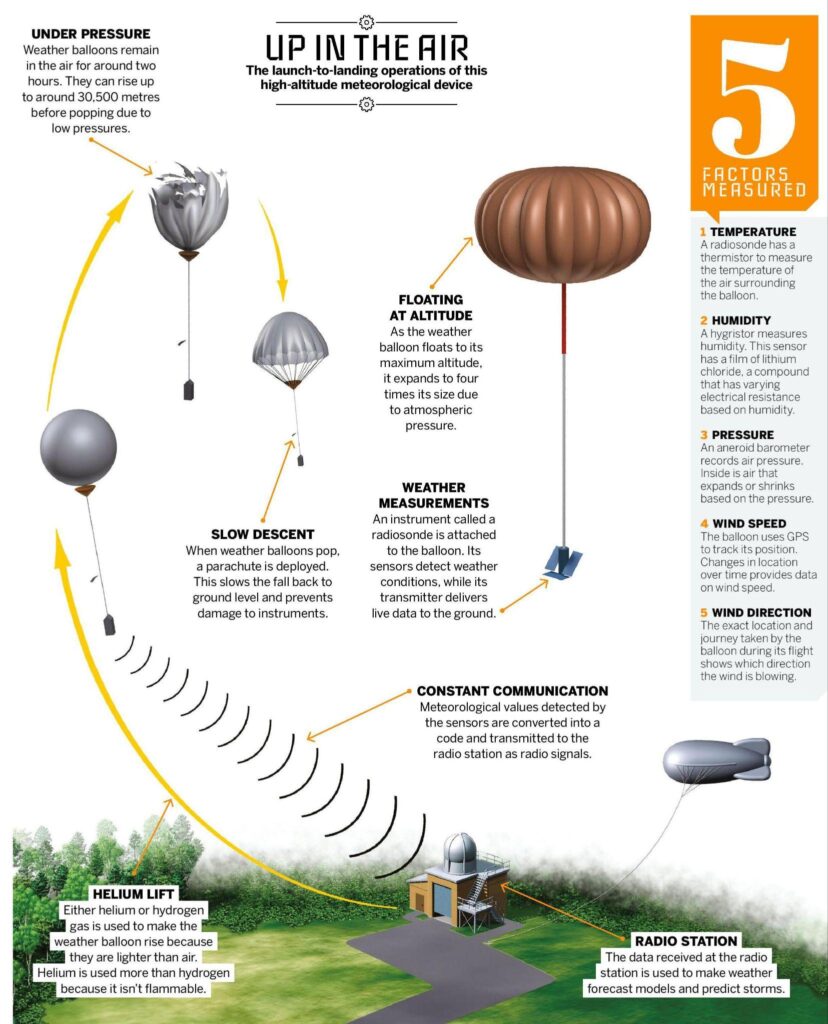
A weather balloon is a large balloon made of latex or synthetic rubber that carries a small instrument package called a radiosonde into the atmosphere. As the balloon rises, it measures atmospheric conditions and sends real-time data back to ground stations.
Weather balloons typically rise up to 30–35 kilometers (18–22 miles) above Earth’s surface, reaching the stratosphere before bursting due to decreasing air pressure.
These balloons are a key part of the global weather monitoring system and are launched twice daily at hundreds of weather stations around the world.
Components of a Weather Balloon System
A weather balloon system consists of three main parts:
1. The Balloon
The balloon itself is usually made of latex or neoprene and filled with helium or hydrogen gas. These gases are lighter than air, allowing the balloon to rise rapidly into the atmosphere.
Key features:
-
Expands as it rises due to lower pressure
-
Can grow up to 6–8 meters wide before bursting
-
Travels at around 5 meters per second upward
2. Radiosonde (Instrument Package)
The radiosonde is the heart of the weather balloon system. It is a small electronic device that measures atmospheric conditions and transmits them to meteorologists on the ground.
The radiosonde measures:
-
Temperature
-
Air pressure
-
Humidity
-
Wind speed
-
Wind direction
-
GPS location
These measurements help meteorologists understand how weather systems behave at different altitudes.
3. Parachute
A small parachute is attached between the balloon and the radiosonde. When the balloon bursts at high altitude, the parachute ensures the instrument descends slowly and safely to the ground.
Sometimes these instruments are recovered and reused.
How Weather Balloons Work
Weather balloons follow a simple but highly effective process.
Step 1: Balloon Launch
Meteorologists release the balloon from a weather station, usually twice per day (00 UTC and 12 UTC) as part of the global meteorological observation system.
Step 2: Ascent Through the Atmosphere
As the balloon rises through the atmosphere:
-
Air pressure decreases
-
The balloon expands
-
The radiosonde continuously records atmospheric data
The balloon typically reaches altitudes of over 30 km.
Step 3: Data Transmission
The radiosonde sends data using radio signals to receiving equipment at the ground station.
Meteorologists receive detailed atmospheric profiles showing how conditions change with altitude.
Step 4: Balloon Burst
At high altitude, the balloon expands until it bursts due to extremely low atmospheric pressure.
Step 5: Safe Descent
After bursting, the radiosonde falls back to Earth using its parachute.
What Data Do Weather Balloons Collect?
Weather balloons provide detailed atmospheric profiles that are impossible to obtain from surface stations alone.
Temperature
Temperature readings help meteorologists understand:
-
Atmospheric layers
-
Storm development
-
Temperature inversions
Humidity
Humidity data is important for predicting:
-
Rainfall
-
Fog formation
-
Cloud development
Air Pressure
Pressure measurements help identify:
-
Storm systems
-
High and low pressure zones
-
Weather front movements
Wind Speed and Direction
Using GPS tracking, meteorologists calculate wind speed and direction at different altitudes.
This information is crucial for:
-
Storm prediction
-
Aviation safety
-
Weather modeling
Why Weather Balloons Are Important
Weather balloons play a critical role in weather forecasting.
1. Accurate Weather Forecasts
Data from weather balloons improves computer weather models used by meteor agencies worldwide.
Without this data, forecasts would be significantly less accurate.
2. Severe Weather Prediction
Weather balloons help meteorologists identify conditions that lead to:
-
Thunderstorms
-
Tornadoes
-
Hurricanes
-
Heavy rainfall
By analyzing atmospheric instability, meteorologists can issue early warnings.
3. Aviation Safety
Airplanes fly within atmospheric layers where wind and temperature changes can affect flight safety.
Weather balloon data helps pilots and air traffic controllers plan safer routes.
4. Climate Research
Scientists also use long-term balloon data to study climate change and atmospheric trends.
This information helps researchers understand:
-
Global warming
-
Changes in atmospheric circulation
-
Long-term climate patterns
How High Do Weather Balloons Go?
Most weather balloons reach heights between:
30 km and 35 km (18–22 miles) above Earth’s surface.
This altitude is far above commercial airplanes and within the stratosphere.
At this level:
-
Air pressure is extremely low
-
Temperatures can drop below −60°C
-
The balloon expands dramatically before bursting
Global Weather Balloon Network
Weather balloons are launched daily from over 900 locations worldwide as part of an international weather monitoring network coordinated by meteorological organizations.
Countries share this atmospheric data globally, which helps meteorologists produce more accurate forecasts.
This collaborative system ensures that weather predictions benefit from data collected across the planet.
Interesting Facts About Weather Balloons
-
Over 100,000 weather balloons are launched globally each year.
-
The radiosonde weighs only about 250–300 grams.
-
Some weather balloons travel more than 200 kilometers horizontally before bursting.
-
Weather balloons can reach three times higher than commercial aircraft.
Future of Weather Balloons
Even with advanced satellites and radar systems, weather balloons remain one of the most reliable sources of atmospheric data.
However, technology is evolving rapidly. In the future, meteorologists may combine balloon data with:
-
Artificial intelligence forecasting systems
-
Advanced weather satellites
-
Autonomous atmospheric drones
These innovations could further improve weather prediction accuracy.
Conclusion
Weather balloons are a simple yet powerful tool used by meteorologists to study the atmosphere. By carrying radiosondes high into the sky, these balloons provide critical data about temperature, humidity, pressure, and wind patterns at different altitudes.
This information is essential for accurate weather forecasting, storm prediction, aviation safety, and climate research. Even in the age of satellites and advanced technology, weather balloons continue to play a vital role in helping scientists understand our planet’s atmosphere.
Frequently Asked Questions (FAQs)
What is the purpose of a weather balloon?
A weather balloon is used to collect atmospheric data such as temperature, humidity, air pressure, and wind patterns at different altitudes to improve weather forecasting.
How high can a weather balloon go?
Most weather balloons reach altitudes between 30 and 35 kilometers (18–22 miles) before bursting.
What instrument is attached to a weather balloon?
A device called a radiosonde is attached to the balloon. It measures atmospheric conditions and sends data back to ground stations.
How often are weather balloons launched?
Weather balloons are typically launched twice a day worldwide at standard observation times.
What happens when a weather balloon bursts?
When the balloon bursts at high altitude, a parachute allows the radiosonde to safely fall back to Earth.