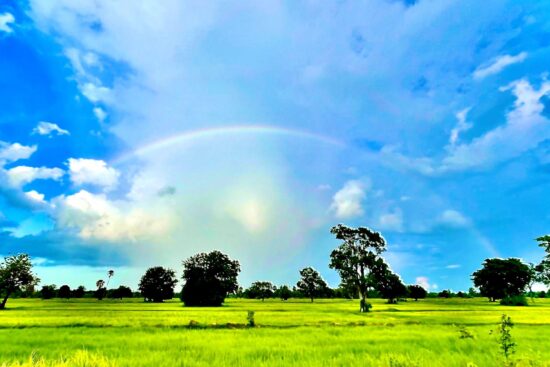
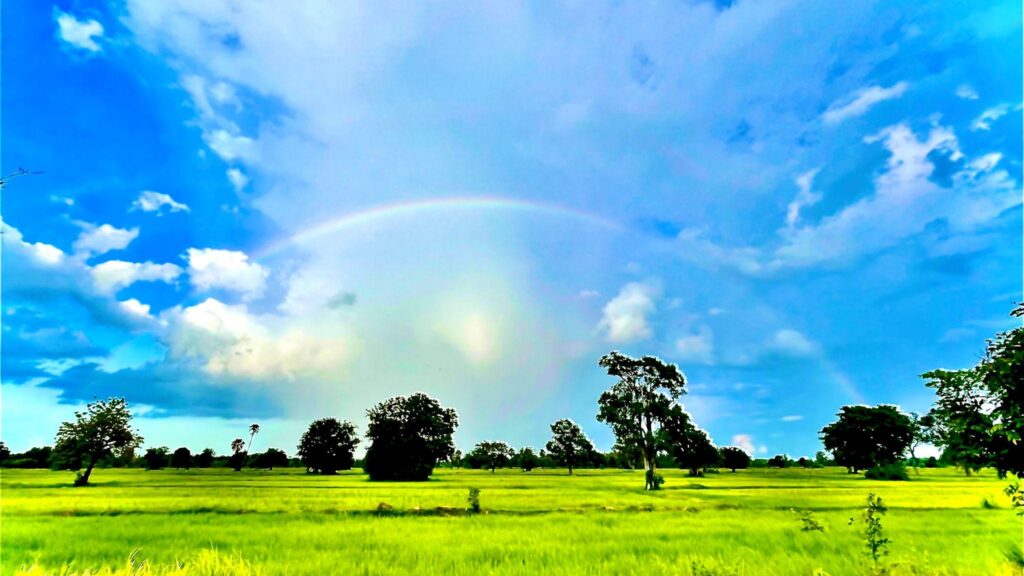
Rainbows are one of nature’s most beautiful and fascinating phenomena. They often appear in the sky after rainfall when sunlight shines through remaining water droplets in the atmosphere. The colorful arc we see is not an actual physical object in the sky but rather an optical effect caused by the interaction of sunlight with tiny water droplets.
Understanding how rainbows form requires looking at how light behaves when it passes through water. The process involves refraction, reflection, and dispersion of sunlight inside raindrops.
Basic Conditions Needed for a Rainbow
For a rainbow to appear, three main conditions must be present:
-
Sunlight must be shining.
-
Water droplets must be present in the air, usually after rain or near waterfalls or mist.
-
The observer must stand with the sun behind them while looking toward the rain.
When these conditions align, sunlight interacts with water droplets in a way that produces the familiar arc of colors in the sky.
Step-by-Step Process of Rainbow Formation
1. Refraction of Sunlight
The first step in rainbow formation occurs when sunlight enters a raindrop. As light moves from air into water, it slows down and bends. This bending of light is known as refraction.
Sunlight appears white, but it actually contains all the colors of the visible spectrum. When the light bends inside the water droplet, it begins to separate into its different colors.
2. Dispersion of Colors
As the refracted light travels inside the droplet, the different wavelengths of light bend at slightly different angles. This separation of white light into individual colors is called dispersion.
The colors that become visible in a rainbow are:
-
Red
-
Orange
-
Yellow
-
Green
-
Blue
-
Indigo
-
Violet
Each color bends at a slightly different angle because each wavelength interacts differently with water.
3. Internal Reflection
After dispersion occurs, the light reaches the back surface of the raindrop. Instead of leaving the droplet immediately, much of the light reflects off the inner surface of the droplet.
This process is called internal reflection, where the light bounces back toward the front of the raindrop.
4. Refraction Again as Light Leaves the Droplet
The light finally exits the droplet and bends again as it moves from water back into the air. This second refraction further spreads out the colors.
By the time the light leaves the droplet, it is separated into distinct colored rays.
Why Rainbows Appear as Arcs
Rainbows appear curved because the light rays reaching your eyes come from millions of raindrops at slightly different angles.
The most intense rainbow light reaches the observer at an angle of about 42 degrees from the direction opposite the sun. All the raindrops that send light at this angle form the circular arc we perceive as a rainbow.
If you were able to view a rainbow from an airplane or high mountain with the right conditions, you might see a full circular rainbow, although from the ground we usually only see a semicircle.
Why Rainbows Appear After Rain
Rainbows commonly appear after rainfall because:
-
Rain leaves many tiny water droplets suspended in the air.
-
When clouds begin to clear, sunlight can pass through those droplets.
-
The interaction between sunlight and droplets creates the rainbow effect.
This is why rainbows often appear when rain is ending and the sun begins to shine again.
What Determines the Colors of a Rainbow
The order of colors in a rainbow is determined by how much each wavelength of light bends.
The color order from top to bottom is always:
Red → Orange → Yellow → Green → Blue → Indigo → Violet
Red light bends the least, which is why it appears on the outer edge of the rainbow. Violet bends the most, appearing on the inner edge.
Double Rainbows
Sometimes you may see a double rainbow, where a faint second rainbow appears outside the main one.
This occurs when sunlight undergoes two internal reflections inside the raindrop instead of one. Because of this extra reflection:
-
The second rainbow is dimmer.
-
The colors appear in reverse order.
Double rainbows are less common but can appear when sunlight and rain conditions are ideal.
Other Natural Situations Where Rainbows Appear
Rainbows are not limited to rainfall. They can also appear in other situations involving water droplets or mist.
Examples include:
-
Waterfalls
-
Ocean spray
-
Garden sprinklers
-
Fog or mist
-
Dew
In each case, the same principles of refraction, reflection, and dispersion apply.
Why Everyone Sees a Different Rainbow
Although many people may look at the same rainbow, each person technically sees their own version of it.
This happens because the rainbow depends on the angle between the observer’s eyes, the sun, and the raindrops. The specific droplets sending colored light to your eyes are different from those sending light to someone else’s eyes.
Therefore, no two people see exactly the same rainbow.
Final Thoughts
Rainbows are created through a beautiful combination of sunlight and water droplets in the atmosphere. The process involves refraction, internal reflection, and dispersion of light within raindrops, which separates sunlight into the familiar spectrum of colors.
Although the science behind rainbow formation is based on physics and optics, the result is one of nature’s most breathtaking sights. Whether appearing after a rainstorm or near a waterfall, rainbows remind us how simple natural elements like light and water can create extraordinary visual displays.
Frequently Asked Questions
Why do rainbows appear after rain?
Rainbows appear when sunlight shines through water droplets left in the air after rainfall.
What are the seven colors of a rainbow?
The seven colors are red, orange, yellow, green, blue, indigo, and violet.
Can rainbows appear without rain?
Yes, they can form in mist, fog, waterfalls, or even sprinkler spray.
Why are rainbows curved?
Rainbows appear curved because light is reflected and refracted at specific angles inside many raindrops.
What causes a double rainbow?
A double rainbow occurs when sunlight reflects twice inside raindrops before reaching the observer.
Can you touch or reach a rainbow?
No, a rainbow is an optical illusion created by light and water droplets, so it cannot be physically reached.