The term “polar vortex” often appears in weather headlines during winter, especially when extreme cold waves strike parts of North America, Europe, or Asia. But what exactly is a polar vortex, and why does it sometimes bring dangerously cold temperatures to regions far away from the Arctic?
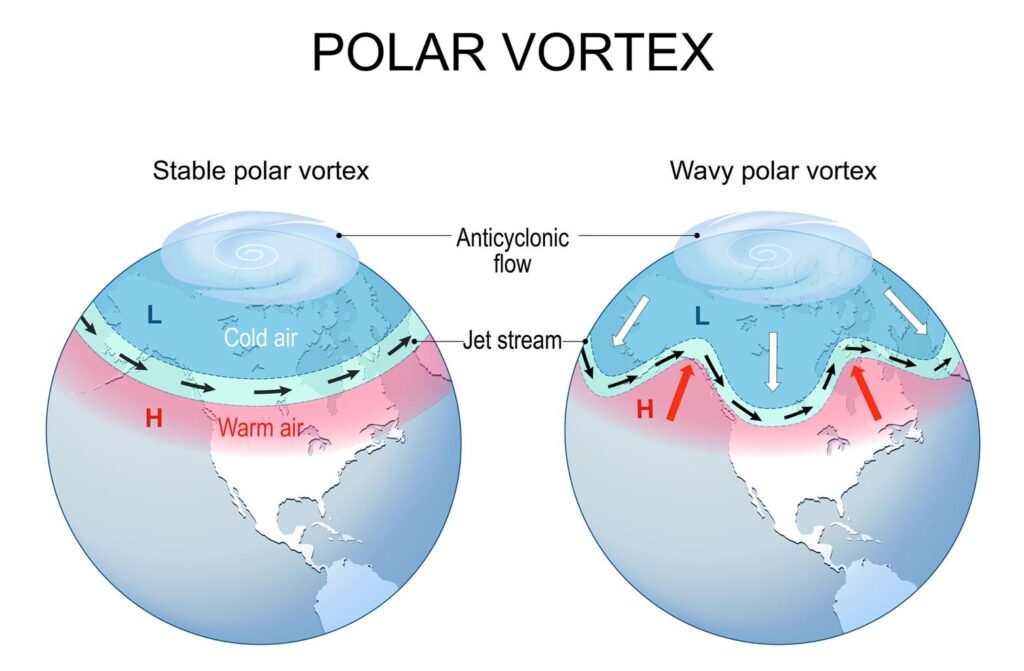
In simple terms, the polar vortex is a large area of low-pressure, cold air that constantly circulates around the Earth’s poles. While it normally stays confined near the Arctic, certain atmospheric changes can push this icy air southward, leading to intense cold spells in many populated regions.
In this guide, we’ll break down what the polar vortex is, how it forms, why it sometimes weakens, and how it leads to extreme winter weather.
What Is a Polar Vortex?
A polar vortex is a massive swirling circulation of frigid air located high in the atmosphere above the Arctic and Antarctic regions.
It is strongest during winter when the temperature difference between the poles and the mid-latitudes becomes very large. This temperature contrast strengthens strong winds in the upper atmosphere, which keep the cold Arctic air trapped near the pole.
Key characteristics of the polar vortex include:
-
Located mainly over the Arctic region
-
Exists in the upper atmosphere (stratosphere)
-
Contains extremely cold air masses
-
Rotates in a counterclockwise direction in the Northern Hemisphere
Under normal conditions, the polar vortex acts like a barrier that prevents the coldest air from spreading south.
Where Does the Polar Vortex Form?
The polar vortex forms above the Earth’s polar regions, especially over the Arctic during the Northern Hemisphere winter.
It exists in two main layers:
1. Stratospheric Polar Vortex
This is the main vortex located about 10–50 kilometers above the Earth’s surface. It is large, stable, and strongest during winter months.
2. Tropospheric Polar Vortex
This occurs closer to the Earth’s surface and is linked with the jet stream, which controls weather patterns in the mid-latitudes.
When the stratospheric vortex weakens or shifts, it can influence the lower atmosphere and lead to major cold outbreaks.
Why Does the Polar Vortex Bring Extreme Cold?
The polar vortex itself does not always cause cold weather outside the Arctic. However, extreme cold occurs when the vortex becomes unstable or disrupted.
When this happens, large pockets of Arctic air break away and move southward.
This can lead to:
-
Sudden temperature drops
-
Severe winter storms
-
Prolonged cold waves
For example, during major polar vortex disruptions, temperatures in some cities can drop 20–30°C below normal.
What Causes the Polar Vortex to Weaken?
Several atmospheric factors can weaken or disturb the polar vortex.
Sudden Stratospheric Warming (SSW)
One of the biggest causes is a phenomenon called Sudden Stratospheric Warming.
During this event:
-
Temperatures in the upper atmosphere suddenly rise
-
Winds around the pole weaken
-
The polar vortex becomes unstable
This can split the vortex into multiple pieces, allowing Arctic air to spill southward.
Jet Stream Disturbances
The jet stream is a fast-moving ribbon of air that flows around the Northern Hemisphere.
When the jet stream becomes wavy instead of flowing smoothly, it can allow cold Arctic air to move into lower latitudes while warm air moves north.
These waves can create strong winter storms and cold snaps.
Arctic Temperature Changes
Changes in Arctic temperatures can also influence the strength of the polar vortex.
When the Arctic warms faster than other regions (a process known as Arctic amplification), it may affect atmospheric circulation patterns, potentially weakening the polar vortex.
Scientists are still researching the exact relationship between climate change and polar vortex behavior.
What Happens When the Polar Vortex Splits?
Sometimes the polar vortex can split into two or more pieces.
When this occurs:
-
Cold air masses move into different regions
-
Multiple areas may experience extreme cold
-
Winter storms may intensify
For example, a polar vortex split could send cold air into:
-
North America
-
Europe
-
Northern Asia
These events can last for days or even weeks.
Famous Polar Vortex Events
Several major polar vortex events have caused record-breaking cold temperatures.
2014 North American Cold Wave
One of the most famous polar vortex events occurred in January 2014, when extremely cold Arctic air moved into the United States and Canada.
Some regions experienced temperatures as low as −40°C.
Cities such as Chicago and Minneapolis saw wind chills that made outdoor exposure dangerous.
2021 Texas Winter Storm
A disrupted polar vortex helped push cold Arctic air deep into the southern United States, leading to a historic winter storm in Texas.
The event caused:
-
Massive power outages
-
Frozen infrastructure
-
Widespread travel disruptions
How Long Do Polar Vortex Events Last?
Polar vortex cold outbreaks can last anywhere from several days to a few weeks.
The duration depends on:
-
Strength of the atmospheric disturbance
-
Jet stream patterns
-
Movement of cold air masses
Sometimes temperatures may briefly warm before another wave of Arctic air arrives.
Can Polar Vortex Events Be Predicted?
Meteorologists can sometimes predict polar vortex disruptions one to two weeks in advance.
Weather scientists monitor:
-
Stratospheric temperatures
-
Jet stream patterns
-
Arctic pressure systems
Advances in weather modeling and satellite data have improved forecasting accuracy for extreme winter events.
However, predicting the exact path of cold air outbreaks remains challenging.
How to Stay Safe During Polar Vortex Cold Waves
Extreme cold from polar vortex events can be dangerous, especially when combined with strong winds.
Here are some important safety tips:
Dress in Layers
Wear multiple layers of clothing, including thermal wear, gloves, and insulated jackets.
Protect Exposed Skin
Frostbite can occur within minutes in extreme cold conditions.
Limit Outdoor Exposure
Stay indoors whenever possible during severe cold warnings.
Prepare Your Home
Ensure heating systems are working properly and insulate exposed pipes to prevent freezing.
Monitor Weather Alerts
Follow updates from local weather services and emergency authorities.
The Polar Vortex and Climate Change
Scientists continue to study whether climate change is affecting the frequency or strength of polar vortex disruptions.
Some research suggests that warming Arctic temperatures could influence atmospheric patterns that lead to more frequent cold outbreaks in certain regions.
However, this topic remains an active area of scientific research, and conclusions are still evolving.
Final Thoughts
The polar vortex is a natural part of Earth’s atmospheric system that plays an important role in winter weather patterns. While it typically remains confined to the Arctic, disruptions in atmospheric circulation can allow frigid air to move southward, bringing extreme cold to millions of people.
Understanding how the polar vortex works helps meteorologists predict cold waves and prepare communities for severe winter conditions.
As weather forecasting technology continues to improve, scientists are gaining better insights into how these powerful atmospheric systems behave and how they may change in the future.
FAQs
What is the polar vortex in simple terms?
The polar vortex is a large rotating area of extremely cold air that normally stays over the Arctic during winter.
Does the polar vortex happen every year?
Yes. The polar vortex exists every winter, but it only causes extreme cold when it becomes unstable or shifts southward.
Is the polar vortex caused by climate change?
The polar vortex itself is a natural phenomenon. However, scientists are studying whether climate change may influence its behavior.
Why does the polar vortex sometimes split?
The vortex can split due to sudden stratospheric warming or disturbances in the jet stream, which allow cold air to move south.
Which regions are affected by the polar vortex?
North America, Europe, and parts of Asia can experience extreme cold during polar vortex disruptions.