
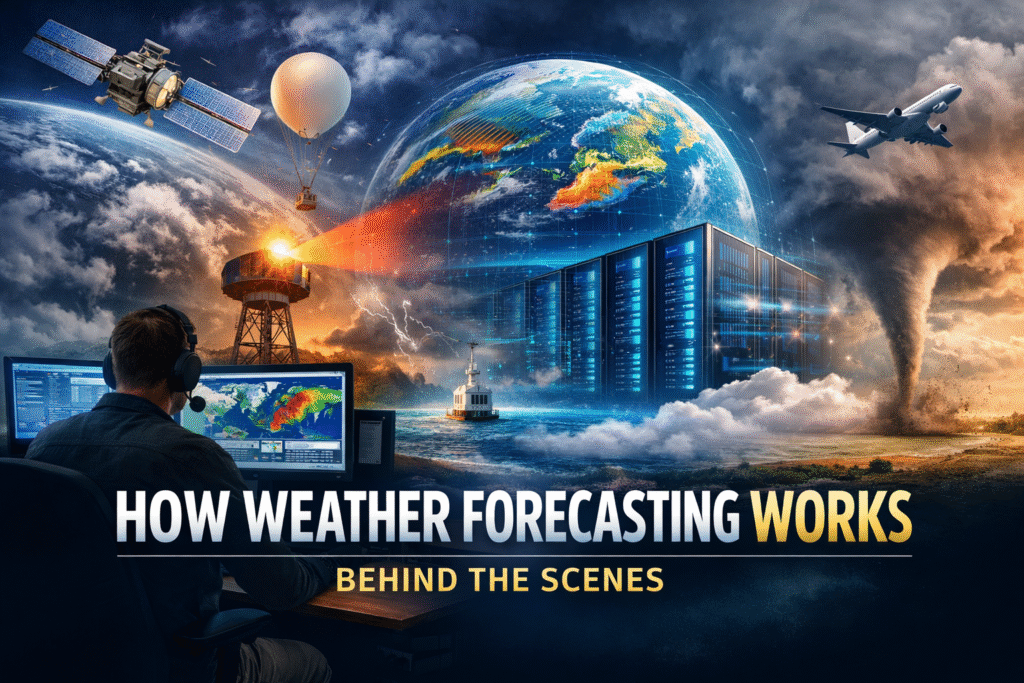
Every time you check the weather app before stepping outside, you’re benefiting from one of the most complex scientific systems in the modern world. A simple prediction like “Rain expected at 4 PM” is the result of satellites orbiting Earth, supercomputers running trillions of calculations, meteorologists analyzing patterns, and advanced models simulating the atmosphere in real time.
But how does weather forecasting actually work behind the scenes? How do experts predict storms days in advance—or sometimes miss them entirely?
Let’s take a deep dive into the science, technology, and human expertise that power modern weather forecasting.
Understanding the Basics: Weather vs Atmosphere
Before we go behind the scenes, it helps to understand what weather actually is.
Weather refers to short-term atmospheric conditions—temperature, wind, humidity, precipitation, air pressure, and cloud cover. The atmosphere is a constantly moving system of air masses interacting with sunlight, oceans, land, and each other.
Forecasting weather means predicting how these atmospheric conditions will change over time in a specific location.
Step 1: Collecting Massive Amounts of Data
Weather forecasting begins with data collection. Without accurate data, predictions would be impossible.
Meteorologists collect information from thousands of sources worldwide, including:
1. Weather Satellites
Satellites orbit Earth and continuously capture images and measurements. They track:
-
Cloud movement
-
Storm development
-
Ocean temperatures
-
Atmospheric moisture
-
Large-scale weather systems
Geostationary satellites stay fixed over one area, while polar-orbiting satellites scan the entire planet as Earth rotates beneath them.
2. Weather Radars
Radars detect precipitation like rain, snow, and hail. They send out radio waves that bounce off particles in the atmosphere and return to the radar station. This helps determine:
-
Intensity of rainfall
-
Movement of storms
-
Potential tornado formation
3. Weather Stations
Ground-based stations measure:
-
Temperature
-
Wind speed and direction
-
Humidity
-
Air pressure
-
Rainfall
There are thousands of automated stations across cities, airports, mountains, and oceans.
4. Weather Balloons
Twice daily, meteorologists launch weather balloons that rise up to 30 kilometers into the atmosphere. These balloons carry instruments that measure temperature, humidity, and wind speed at different heights.
This vertical data is critical because weather systems develop in layers, not just at ground level.
5. Ocean Buoys and Ships
Oceans influence global weather patterns. Buoys measure sea surface temperature, wave height, and atmospheric pressure.
Step 2: Feeding Data into Supercomputers
Once data is collected, it’s sent to powerful supercomputers. These machines process millions of data points every second.
Weather forecasting relies on numerical weather prediction (NWP). This method uses mathematical equations based on physics to simulate how the atmosphere behaves.
The models account for:
-
Fluid dynamics
-
Thermodynamics
-
Solar radiation
-
Earth’s rotation
-
Surface friction
Supercomputers divide the atmosphere into 3D grids. Each grid box contains atmospheric data like temperature and wind. The computer calculates how each box will interact with neighboring boxes over time.
Because the atmosphere is chaotic, even tiny changes in data can lead to different outcomes. That’s why forecasts sometimes change from one day to the next.
Step 3: Running Forecast Models
There isn’t just one weather model. There are many, and each has strengths and weaknesses.
Major forecasting centers around the world run their own models. These models simulate weather hours, days, and sometimes weeks into the future.
Some models are better at predicting hurricanes. Others are more accurate with temperature trends. Meteorologists compare multiple models to look for agreement or differences.
If several models show the same storm forming, confidence in the forecast increases.
Step 4: Ensemble Forecasting
Because weather is unpredictable, meteorologists don’t rely on a single model run.
Instead, they use ensemble forecasting. This means running the same model multiple times with slightly different starting conditions.
If most runs predict rain, forecasters are confident. If results vary widely, the forecast becomes less certain.
This is why you see forecasts expressed as percentages, like:
“60% chance of rain.”
That percentage reflects the probability based on model agreement.
Step 5: Human Meteorologists Analyze the Data
Despite advanced technology, human expertise is still essential.
Meteorologists analyze:
-
Satellite imagery
-
Radar scans
-
Model comparisons
-
Historical patterns
-
Local climate behavior
Computers generate raw data, but humans interpret it. For example, a model might show heavy rain, but an experienced meteorologist may recognize that local geography could weaken the storm.
Local forecasting knowledge makes a big difference.
Step 6: Issuing Forecasts and Warnings
Once meteorologists finalize predictions, they issue forecasts through:
-
Weather apps
-
TV broadcasts
-
Government agencies
-
Emergency alert systems
For severe weather events like hurricanes, cyclones, or tornadoes, official warnings are issued to protect lives and property.
Forecast updates happen frequently because new data arrives constantly.
Why Forecasts Change
Many people get frustrated when forecasts change. But weather systems are dynamic and influenced by many variables.
Reasons forecasts change:
-
New satellite data
-
Updated model runs
-
Unexpected storm movement
-
Rapid temperature shifts
-
Ocean surface temperature changes
The closer you are to an event, the more accurate the forecast becomes.
How Accurate Are Modern Forecasts?
Weather forecasting has improved dramatically over the last 30 years.
Today:
-
1-day forecasts are about 95% accurate
-
3-day forecasts are highly reliable
-
5-day forecasts are generally dependable
-
7–10 day forecasts are useful but less certain
Beyond 10 days, predictions become increasingly uncertain due to atmospheric chaos.
The Role of Artificial Intelligence
Artificial intelligence is now transforming forecasting.
AI can:
-
Analyze massive historical weather datasets
-
Detect hidden patterns
-
Improve short-term precipitation prediction
-
Enhance severe storm tracking
AI models can process data faster than traditional systems and improve accuracy in some cases.
However, AI still works alongside traditional physics-based models—not as a complete replacement.
The Future of Weather Forecasting
Weather forecasting continues to evolve with:
-
More advanced satellites
-
Faster supercomputers
-
Higher-resolution models
-
Improved radar systems
-
AI-driven analysis
Scientists are also working on hyper-local forecasting, which predicts weather at street-level precision.
In the future, forecasts may become even more personalized, giving real-time predictions tailored to your exact location.
Why Weather Forecasting Matters
Weather forecasting isn’t just about deciding whether to carry an umbrella.
It protects:
-
Aviation
-
Agriculture
-
Shipping
-
Disaster response
-
Energy management
-
Public safety
Accurate forecasting saves lives and billions of dollars every year.
From early cyclone warnings to heatwave alerts, modern forecasting systems play a critical role in global safety.
Frequently Asked Questions (FAQ)
1. How far in advance can weather be predicted accurately?
Short-term forecasts (1–3 days) are very accurate. Forecasts up to 7 days are fairly reliable. Beyond 10 days, accuracy decreases significantly.
2. Why is predicting rain so difficult?
Rain depends on small-scale atmospheric conditions like moisture and temperature shifts. Even minor changes can alter storm development.
3. What is the most accurate weather model?
There isn’t one single “most accurate” model. Meteorologists compare multiple models and use ensemble forecasting to improve reliability.
4. Why does the weather app show different forecasts than TV news?
Different services may use different models, update times, or interpretation methods. Small variations in data can lead to slightly different predictions.
5. Can weather ever be predicted perfectly?
No. The atmosphere is a chaotic system. Tiny differences in starting conditions can create different outcomes over time.
6. Why do forecasts become more accurate closer to the date?
Because new data constantly updates models. The closer we are to an event, the fewer unknown variables remain.
Final Thoughts
Behind every simple weather forecast is a complex global system powered by satellites, radars, weather balloons, supercomputers, mathematical equations, and human expertise.
While weather will never be perfectly predictable, modern forecasting is more advanced and accurate than ever before.
The next time you check the forecast before planning your day, remember—you’re looking at the result of one of the most sophisticated scientific processes on Earth.